


The Complete Guide to Applicant Screening Questions
The right screening questions ensure that only the most qualified applicants progress in the hiring process. This allows you to spend less time with unqualified applicants and more time with the applicants best suited for the job.
Contents
- What are applicant screening questions?
- Why should I use screening questions during employee selection?
- The two types of screening questions
- How to score screening questions
- Example screening questions with scoring criteria
- Avoiding bias in applicant screening questions
- What not to do with screening questions
- How to get started
1. What are applicant screening questions?
Applicant screening questions are used to screen out applicants who do not meet the minimum requirements of a job. Screening questions are often delivered through short online questionnaires that are completed as part of an initial application process.
More complex applicant screening questions can also be used during a recruiter screening interview. Combining two approaches can provide a more cost-effective and efficient hiring process.
Here are a few key characteristics of good screening questions:
- Screening questions ask if an applicant meets minimum job requirements.
- Screening questions are focused on job and company fit.
- Screening questions are direct; they don't try to trick candidates.
- Screening questions are simple to understand and not designed to confuse applicants.
2. Why should I use screening questions during employee selection?
Candidate screening is the process of evaluating job applicants against specific criteria to determine their suitability for a role before advancing them to interviews. Applicant screening questions are structured inquiries used to systematically filter candidates based on minimum job requirements, skills, and company fit.
Hiring unqualified, ineligible, or mismatched applicants often leads to turnover, which has costly results. Screening questions filter unsuitable applicants from progressing in your selection process and minimize risk. Using applicant pre-screening questions as an initial step in an employee selection process can help you quickly and effectively identify candidates that clearly don't match the company or the job. These questionnaires are short (10 questions or less) and ask candidates to answer a series of questions related to their ability to meet the specific and critical needs of the job or the company.
Applicant screening questions can efficiently reduce initial applicant pools to a reasonable number of candidates that recruiting teams and hiring managers can effectively manage. When facing large volumes of candidates or looking for very specific skills or backgrounds, applicant screening questions allow you to filter through the least qualified applicants and identify people who meet the requirements with the skills and qualities necessary to be successful.
When combined with an adaptive system that identifies which screening questions are making a difference and which aren't, your hiring system becomes more efficient and creates more time for the most critical steps in the hiring process, including interviews and work samples.
↑ Back to top3. The two types of screening questions
There are two main types of questions that will help screen out the wrong applicants. Each type has a specific purpose in the screening process.
Type 1: Eligibility Screening Questions
Eligibility screening questions measure if an applicant is actually eligible for consideration of employment in a given position. These questions address black-and-white requirements that must be met before any other evaluation should take place.
These questions typically measure things like:
- Compensation: Is the applicant willing to accept the pre-determined compensation for this role?
- Start Date: Can the applicant start this position in an acceptable time frame?
- Employment Status: Is the applicant authorized to work in the required environment legally?
- Location: Is the applicant able to be in the required physical location?
- Willingness to Complete the Process: Is the applicant willing to complete the necessary hiring steps?
See a full list of sample Eligibility Screening Questions in our Screening Question Library.
Type 2: Job Performance Screening Questions
Another type of screening question relates to the applicant's ability to perform the required tasks of the job. These attributes are generally measured after the initial screening for basic eligibility but can also be a powerful tool for filtering out applicants who do not meet the minimum performance requirements. These questions often measure education, certifications, experience, and other relevant skills.
Each performance-based question will be unique to the position you are hiring for, while the eligibility questions are more generalized across job roles.
These questions typically measure things like:
- Education: Does the applicant have the minimum education requirements?
- Certifications: Does the applicant have the required certifications or licenses?
- Experience: Does the applicant have the necessary experience to be successful?
- Other Skills: Are there other skills that are required for this position?
See a full list of sample Job Performance Screening Questions in our Screening Question Library.
Remain focused on the most critical questions that need to be answered and respect the time it takes for candidates to fill out any pre-screening questionnaire. In today's marketplace, people apply to dozens of jobs, and the company that values a candidate's experience by being respectful of their time and communicative will gain a reputation as a good employer, leading to more recruiting success in the future.
Some argue that screening questions are "easy to game," but even if a person does game the question, many others answer truthfully. Falsified screening questions can also be a useful tool for recruiters and hiring managers to identify the integrity of candidates. For instance, if a person responds that they meet all of the minimum requirements, but a review of their resume suggests otherwise — that's new information about whether that candidate will be a good addition to your company.
In summary, pre-screening questions can help you identify applicants who do not meet your minimum "deal breaker" requirements and help you identify applicants who might lack integrity. This allows you the confidence to move through the hiring process knowing you are focused on the most qualified applicants.
↑ Back to top4. How to score screening questions
There are multiple ways to score pre-screening questions based on the needs of the job and the characteristics of the applicant pool.
If you have a large applicant pool (e.g., entry-level job, unique skills needed, low job complexity) then using simple "Yes" and "No" questions can help you quickly and easily select people out of the hiring pipeline.
If you have a smaller potential applicant pool (e.g., non-entry-level job, multiple possible ways to be successful, high complexity) then using Likert-Scale (multiple options in a range) or checkboxes in place of Yes/No questions can help you rank-order candidates based on how much they fit the desired attributes or needs of the job.
It's important to check work history accuracy — check resumes and ask pointed questions in telephone screening interviews. The more complex a skillset or background is, the less likely any one person will meet the requirements. An applicant responding as high as possible on every question about past experience and skillset might be a turnover risk if the role won't challenge them. It could also indicate potentially exaggerated responses.
Finally, you can allow people to compose written responses to questions by asking them to describe how their previous experience, skills, or background might make them a good fit for the challenges of the role. Applicants can also respond to skill prompts (e.g., if persuasive writing is a requirement for the role). You might also ask them to list the salary they are looking to achieve or explain their timeline for accepting a new job.
Keep it brief
If you ask candidates to compose written responses, be mindful of the time required. Written prompts may also require more skill and awareness from recruiters about the role's needs and what a good answer looks like. It's often better to allow a cover letter to replace written compositions than to ask for complex responses in initial screening.
5. Example screening questions with scoring criteria
Example questions are separated by the overall category they are measuring.
To see a comprehensive list of screening questions, explore our Screening Question Library.
↑ Back to top6. Avoiding bias in applicant screening questions
There's an unfortunate statistic that suggests male candidates will apply for a job even if they only meet 60% of the qualifications, yet female candidates only apply if they match the qualifications exactly.
You can avoid biasing a job away from women applicants by:
- Avoiding terms or descriptions of jobs that are biased or gendered in the way they are described or the verbs used.
- Avoiding requirements creep by focusing only on what the bare minimum to do the job effectively requires — in both the job description and screening questions.
Remember, screening questions are tools to identify who does not meet the minimum requirements. Clearly identifying what those minimum requirements are is critical for reducing bias. Do not use screening questions to see if people have "desirable but not necessary" skill sets or backgrounds. Do ask screening questions to see whether candidates can immediately perform the minimum necessary to do the core functions of a job — not those which can be trained on the job.
↑ Back to top7. What not to do with screening questions
Previous compensation or salary
A growing number of states now deem it illegal to ask candidates questions about their previous compensation. These questions are often considered complicit in continuing pay imbalance between men and women. Further, asking this kind of question can put your company in a poor light. You should ask candidates what they want to be paid instead of what they were paid previously.
Technology
Screening candidates based on their comfort or skill with new technologies can be seen as a proxy for age discrimination, which is illegal under the Age Discrimination in Employment Act of 1967. Technology or computer-relevant screening questions must be clearly job-relevant to avoid legal challenge.
Non-job-relevant questions
Applicant screening questions are considered employment tests and carry legal burden along with every other step in the selection process. Screening for anything that is not directly relevant to the job should be avoided at all costs. This includes anything related to hobbies, religious or family background, marital status, and current employment.
Protected class status
Protected classes include race, sex, national origin, color, age (40 years or older), and disability. It is illegal to intentionally (or unintentionally) use selection tools to discriminate against people in these classes. Keep your questions broad and avoid asking questions that could be interpreted as inquiring about protected class membership.
For instance, if you are looking to hire a bilingual employee, you can ask whether a candidate is fluent in written and spoken Spanish — but you should never ask whether they are Latino or have "native" fluency, as these could be considered questions relating to race or national origin.
Consistency is key
Always ask the same screening questions for every candidate. Never ask different questions based on a person's demographics or protected class membership. Get feedback from multiple, diverse individuals to ensure you don't ask an illegal screening question.
8. How to get started
Using screening questions to make your hiring process more efficient allows you to spend more time with applicants who are a good fit. If you're not currently using applicant screening questions, start by looking at your job req for things the applicant must have in order to progress in the hiring process.
The key is necessity. If the applicant "must" be a US citizen to be considered for this position, ask that as early as possible. If they "must" have 10 years of sales experience, ask that as early as possible. Avoid questions that are "nice to haves" or difficult to evaluate with a self-answered question. For example, communication might be a "must have," but it's an attribute that is very hard to confidently determine from a survey question.
Below is an example of how you can use a job req to identify attributes that can be screened with questions. Screening questions are highlighted in red:
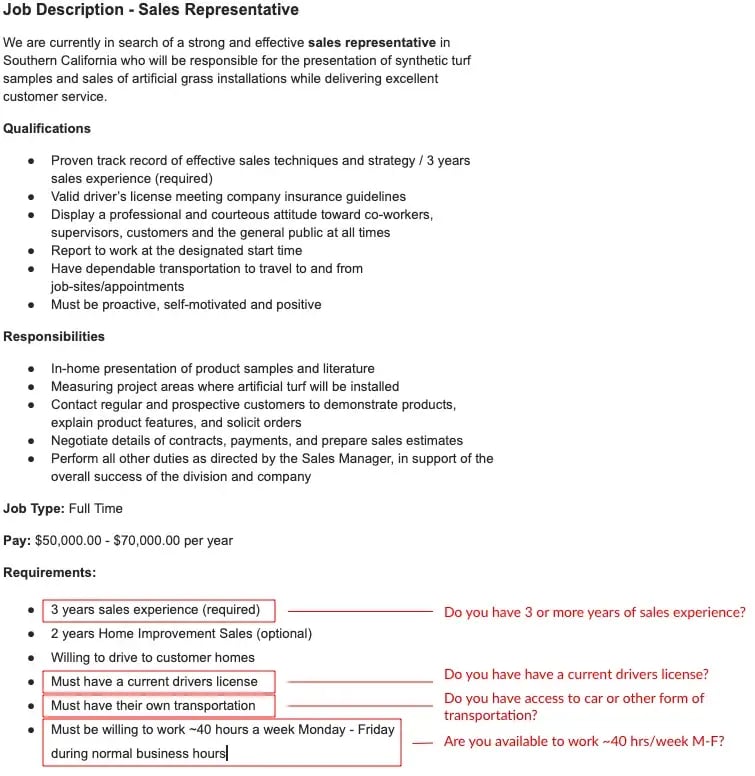
Remember — the more you can ask up front, the more likely the applicant will be to continue through the entire recruiting process.
Another great tool to get started is to explore our Screening Question Library and see which questions work for your needs.
↑ Back to topPut Your Screening Questions to Work
Journeyfront automates candidate screening so your team can focus on the most qualified applicants from the start.
Request a Demo Browse Question Library