
SUMMARY
Industry:
BPO, healthcare and insurance customer experience
Job Function:
US healthcare agents (licensed), customer care
Scale:
22,186 healthcare agent hires, including 5,514 US licensed healthcare agents
Partnership:
Since April 2024; expanded to the Philippines (2025) and India
Problem:
High-volume healthcare hiring on client deadlines, manual screening, and an assessment vendor that couldn't be customized
Result:
48% reduction in time to hire (11.5 → 6 days)
51% reduction in 90-day turnover (59% → 29%)
56% reduction in 60-day turnover (48% → 21%)
How Everise, a global BPO serving healthcare and insurance clients, built healthcare agent hiring around prediction: nearly halving time to hire from 11.5 days to 6, and reducing 90-day turnover by 51% across its US healthcare agent population.
US healthcare agent roles. Time to hire averaged through Feb 2026; turnover compared by hire-date cohort, Q3 2024 baseline against Q3–Q4 2025 cohorts.
The Challenge
Everise sells outcomes to some of the largest health insurance companies in the United States. Meeting those commitments means onboarding healthcare agents by the thousands, against client deadlines that do not move.
By 2024, the hiring engine behind that promise was straining. Workday served as the system of record, but the screening that determined who actually made it into a class sat in a separate assessment tool, one that could not be shaped around Everise’s roles or its individual client programs. Large parts of the process in between were manual.
Their prior assessments couldn’t be customized
Everise had already invested in an assessment solution. It “had not helped drive the efficiencies or outcomes desired due to limited customizability.” A generic screening instrument cannot distinguish a candidate who will pass a Medicare certification exam and stay through open enrollment from one who will not. For healthcare agent roles, that distinction is the entire economic question.
Process changes rested on anecdote
There was no feedback loop between what happened during hiring and what happened after it. When the team changed a step, they had no way to know whether the change helped. Decisions about a process running tens of thousands of candidates a year were being made on impressions.
The cost showed up in the first 60 days
Healthcare agents are expensive to acquire and expensive to lose. Everise carries the cost of licensing, certification and program-specific training before an agent takes a single call. In Q3 2024, 48% of newly hired US healthcare agents were gone within 60 days, after Everise had paid for all of it.
| Baseline metric | Value | Period measured |
|---|---|---|
| 60-day turnover | 48% | Q3 2024 cohorts |
| 30-day turnover | 25–26% | Q3–Q4 2024 cohorts |
| Time to hire | 11.5 days | Pre-Journeyfront |
Turnover baselines measured on US healthcare agent cohorts.
The Journeyfront Solution
Journeyfront did not replace Workday. It replaced guesswork, layering role-specific screening, insurance-specific simulations and predictive hiring profiles onto the system of record Everise already ran.
Screening built for the role, not for everyone
Implementation opened with a deep dive across eight roles to establish what each one actually required. Journeyfront then configured behavioral assessments and language tests to those definitions and built eight custom role-specific job simulations, so candidates work a realistic version of the job before anyone decides on them.
An automated path from application to interview
A pre-screen filter runs first. Candidates who clear it are advanced automatically into assessments and simulations, and those who pass route straight to interview self-scheduling. Language knockouts enforce a hard threshold before a recruiter spends a minute. No manual hand-offs between steps.
“We observed an increase in candidates complying with assessments, or finishing the assessments right away.”
Everise, Talent Acquisition
Predictive profiles per client program
The step that changed the economics: Journeyfront analyzed Everise’s own hire data to find the traits that actually predicted retention in these roles, then built them into predictive hiring profiles used for live screening. The models began with a single client program and were extended to all US roles, then to six individual healthcare lines of business, each with pass thresholds tuned to its own risk profile: conservative on advancement, aggressive on auto-reject only for very low scores.
A closed loop, finally
Post-hire outcomes, turnover and performance, feed back into the models on a standing cadence. The hiring process now learns from its own results instead of from opinion.
In production at Everise
- ✓ Job analysis and role profiling (8 roles)
- ✓ Prescreening with dynamic disqualifiers
- ✓ Behavioral assessments
- ✓ Skills tests (typing, computer skills)
- ✓ 8 custom job simulations
- ✓ Language assessments (expanding)
- ✓ Interview guides and scorecards
- ✓ Interview self-scheduling
- ✓ Predictive hiring profiles (18 models)
- ✓ Automation rules (advance / reject)
- ✓ Funnel analytics and dashboards
- ✓ Quality-of-hire and post-hire analytics
- ✓ Workday integration
- ✓ Video screening question
How It Rolled Out
From signature to first screened hire in 77 days, then two years of compounding expansion.
| When | Milestone | What happened |
|---|---|---|
| Apr 2024 | Contract and kickoff | Partnership signed and kicked off in April. Role definition deep dive across eight roles; Workday integration begun. |
| Apr–Jun 2024 | Build and training | Behavioral assessments and language tests configured; eight custom insurance-specific simulations built; screening plans approved with TA leadership; admin and recruiter training delivered. |
| Jul 2024 | Launch, 77 days from kickoff | First hire screening on July 1. Pre-screen filter, automated advancement into assessments and simulations, and interview self-scheduling live end to end. |
| Late 2024–2025 | The predictive phase | US healthcare predictive assessments launched, starting with a single client program and pushed to all US roles. Traits predicting retention identified in Everise’s own data and built into live screening. |
| Apr 2025 | Geographic expansion | The platform extends beyond the US into the Philippines. |
| 2025–2026 | Line-of-business model buildout | Predictive performance and retention models per healthcare line of business; auto-advance and auto-reject cutoffs tuned per role; India team onboarded. |
| Apr 2026 | Continued expansion | Scope broadened again into additional roles and regions. |
Optimizations found in the data
- Computer-skills items moved into a separate screening step rather than removed, cutting prescreening time without losing the signal.
- The Medicare assessment shortened to roughly ten questions while retaining core knowledge requirements, with impact monitored.
- Predictive score cutoffs tuned per line of business: conservative pass thresholds, aggressive auto-reject reserved for very low scores.
Results & Impact
Time to hire nearly cut in half
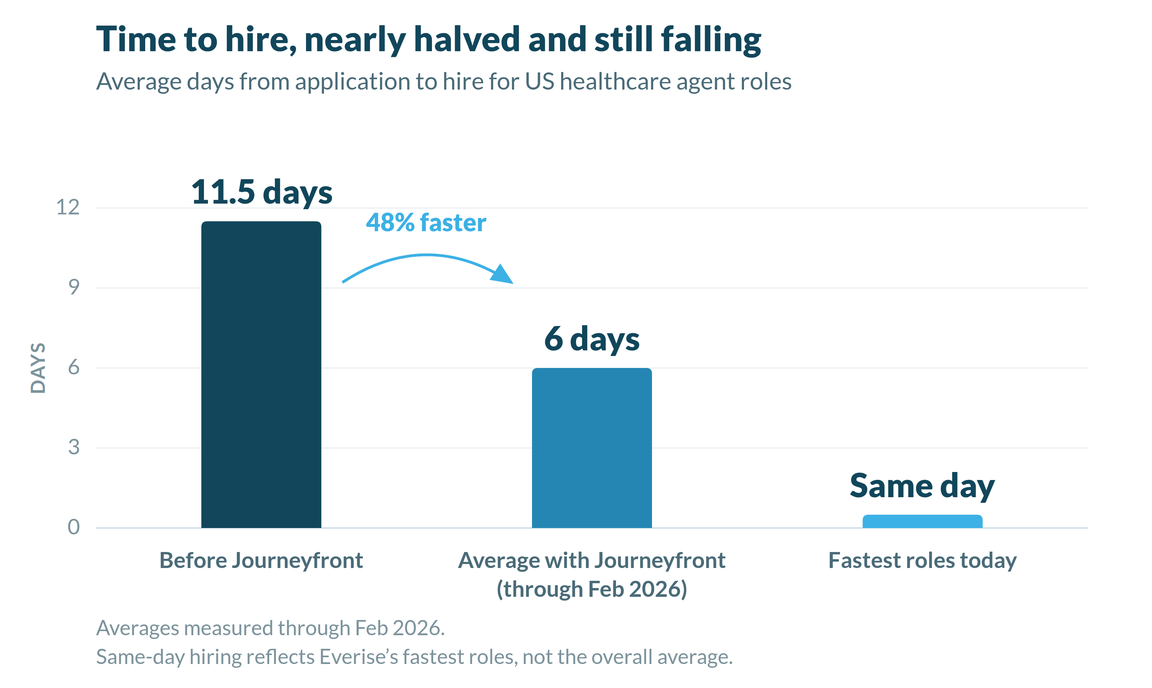
Speed was the first result Everise felt. Before Journeyfront, moving a healthcare agent from application to hire took an average of 11.5 days. Automating that path, from pre-screen through assessments and interview self-scheduling, cut the average to 6 days, a 48% improvement. On Everise’s fastest roles, candidates now go from application to hire the same day they apply. For a business staffing client programs against fixed deadlines, that speed is capacity.
| Metric | Before | After | Change | Period |
|---|---|---|---|---|
| Time to hire | 11.5 days | 6 days | −48% | Through Feb 2026 |
| 30-day turnover US healthcare agents | 25–26% | 15% | −42% | Q3–Q4 ’24 → Q3 ’25 |
| 60-day turnover US healthcare agents | 48% | 21% | −56% | Q3 ’24 → Q3 ’25 cohorts |
| 90-day turnover US healthcare agents | 59% | 29% | −51% | Q3 ’24 → Q4 ’25 cohorts |
Turnover in steps
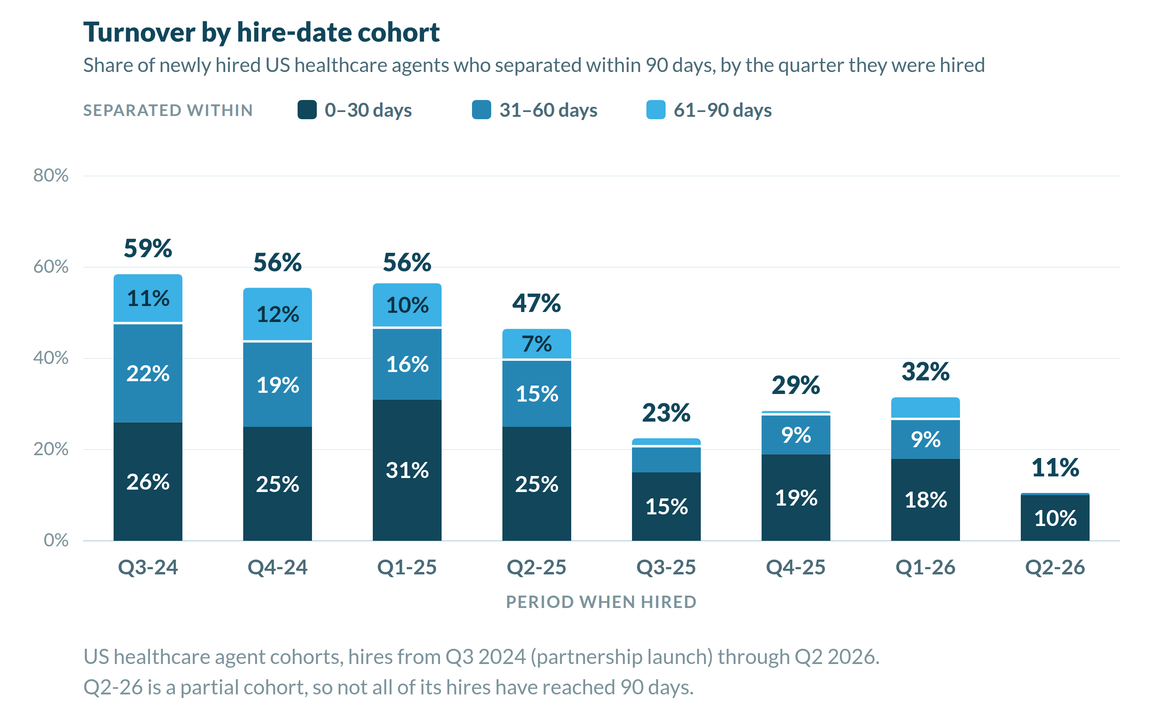
The chart below shows the closed loop at work, starting with the first cohorts hired through Journeyfront in Q3 2024, when 59% of new healthcare agents left within 90 days. Turnover fell with each round of optimization, reaching 23% by Q3 2025 and holding near 30% as hiring scaled through early 2026. Exits in the critical first 30 days dropped from 26% to 18%.
Beyond the numbers
- The relationship compounded. An initial US launch in 2024 became a Philippines deployment in 2025, an India team, and a further 2026 expansion adding roles and lines of business.
- Hiring decisions became evidential. Everise moved from anecdote to a closed loop in which post-hire outcomes continually refine who gets screened in, with distinct insight per client program.
- Executive attention followed the results. The CIO and SVP of Digital Transformation are now driving deeper integration: PowerBI executive reporting, BYOD device qualification, and AI interview scoring.
Looking Ahead
Everise and Journeyfront are extending the same principle, decide with data, into reporting, devices and the interview itself.
- Executive reporting. A daily PowerBI feed from Journeyfront into Everise’s executive reporting layer, requested by the SVP of Digital Transformation.
- AI interview scoring. Strong interest in extending scoring into video screening and interviews.
- BYOD qualification. System and specification testing plus candidate-database search to find device-qualified candidates, protecting funnel volume as device requirements tighten.
- Deeper Workday integration. Pushing scores, screening data and fraud indicators back into Workday so the system of record carries the intelligence too.
- Continued geographic expansion. India growth, added languages, and the AI-recruiter integration relaunch.
“Being able to identify what program they’re a best fit for is a hundred percent more beneficial for my team, because we can move through that a lot faster.”
Everise, Talent Acquisition lead
More BPO Case Studies
Related Resources